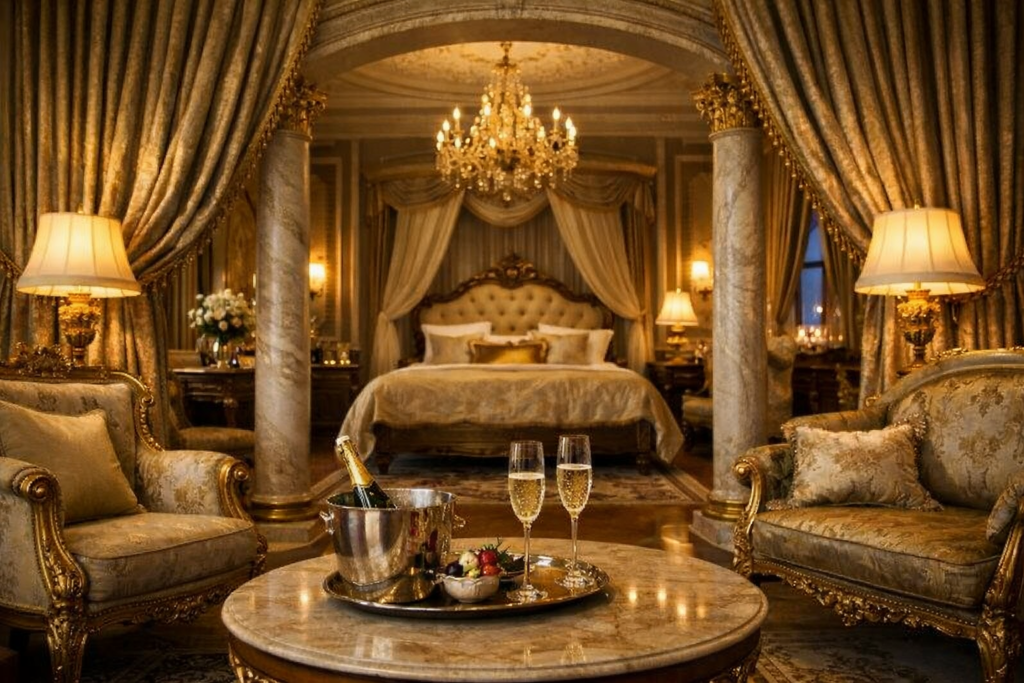
Luxury Stays That Feel Like a Private Palace
Why Palace-Style Luxury Travel Is Having a Major Moment
There is a reason luxury stays that feel like a private palace have become one of the most magnetic corners of modern travel. Affluent travelers are not just hunting for expensive rooms anymore. They are looking for emotional insulation, architectural drama, and the kind of service that makes everyday life feel very far away. The latest Virtuoso Luxe Report shows that luxury clients in 2025 continue to prioritize personalized experiences, while also paying close attention to value, which means travelers are not simply spending for the sake of spending. They want every dollar to translate into privacy, meaning, ease, and memory-making. That same report places beach resort stays and exclusive use experiences such as private villas, yachts, and jets among the major luxury travel trends shaping 2025.
You can see the same shift in the broader luxury hospitality market. Forbes Travel Guide’s 2025 Star Awards covered more than 2,100 properties across 90 countries, and its inspectors highlighted a changing definition of luxury built around authentic experiences, well-being, and unforgettable moments, not just gold-plated décor or oversized suites. That is a big clue. Today’s traveler wants a stay that feels regal, but never stiff; grand, but never generic. In other words, the modern palace fantasy is not about living like a museum piece. It is about stepping into a space where everything feels curated for you, from the scent in the lobby to the pace of breakfast on your terrace. That is why the phrase private palace hotel experience resonates so strongly right now: it captures both the visual splendor travelers want and the emotional privacy they increasingly refuse to compromise on.
What Makes a Luxury Stay Feel Like a Private Palace
A true palace-style hotel stay is not created by marble alone. Plenty of properties have chandeliers, polished stone, and sweeping staircases, but only a smaller group actually delivers the sensation of having your own world inside their walls. That feeling comes from a blend of scale, privacy, intuitive service, spatial control, and a sense that nothing is being mass-produced. The strongest properties understand something simple: luxury is not just what you see; it is what you never have to think about. You do not think about waiting. That do not think about noise. You do not think about logistics. That you do not think about whether someone will understand your preferences, because they already do. That is where ordinary high-end hospitality ends and private palace luxury begins.
This is also why so many of the world’s most celebrated stays now lean into villa collections, mansion-style suites, butler service, private pool accommodations, and destination-led design. Forbes Travel Guide notes that exceptional service accounts for 70% of a property’s rating, while facilities account for the remaining 30%. That ratio says a lot. A palace feeling is not built by square footage alone. It is built by orchestration. A room can be huge and still feel cold. A resort can be expensive and still feel exposed. The magic happens when architecture, staff precision, and emotional intelligence come together so smoothly that the guest feels both honored and at ease. Think of it like a symphony rather than a showroom. The finest luxury hotels do not merely display wealth; they conduct atmosphere.
Architecture, Space, and the Power of Grandeur
The first signal of a private palace stay is architectural presence. Grandeur still matters because physical space changes psychology. High ceilings, framed vistas, formal courtyards, oceanfront pavilions, colonnades, private gardens, and oversized terraces all send the same message to the guest: breathe deeper, move slower, you have room here. That matters more than people sometimes realize. Luxury is partly a visual experience, but it is also a nervous-system experience. When you enter a property with dramatic proportions and carefully structured quiet, your body immediately registers relief. The stay begins before the keycard, before the welcome drink, before the luggage arrives.
Yet the most compelling properties in 2025 go beyond copying old-world palaces. They reinterpret grandeur through local identity. Forbes Travel Guide specifically pointed to a stronger sense of place on its 2025 list, noting how local customs, history, décor, and cuisine are being integrated into luxury hospitality. That is why a palace-like stay in Hanoi might draw from opera history and artisanal traditions, while a palace-like retreat in Seychelles might use nature, wildlife, and island heritage to shape the guest experience. Even Hilton’s luxury portfolio expansion reflects this appetite for location-driven distinction, with marquee luxury growth stretching across destinations such as London, Costa Rica, Hanoi, Jakarta, Sydney, Osaka, Riyadh, and Tokyo. The message is clear: modern luxury accommodation needs grandeur, but it also needs identity. Without that, opulence starts to feel like costume jewelry—bright from a distance, hollow up close.
Privacy, Service, and the Feeling of Effortless Control
Ask most seasoned luxury travelers what they actually remember, and they rarely begin with the chandelier. They talk about how the stay made them feel. That is why privacy and service sit at the center of the palace effect. A guest feels regal not because they are being watched, but because everything works without friction. The arrival is seamless. The butler is present, but never intrusive. Dining can move from restaurant to terrace to villa without turning into an operational problem. Spa appointments are adjusted around the guest’s rhythm rather than forcing the guest into a timetable. This is the hospitality equivalent of invisible architecture. You may not notice it in every moment, but you would absolutely feel the absence of it.
Current traveler behavior supports that reading. Hilton’s 2025 travel research found that 63% of travelers value the option of a digital room key, which reveals a strong appetite for smoother, less interrupted movement. At the same time, 24% of global travelers say they disconnect from social media more than they used to on vacation, suggesting that luxury is also becoming a refuge from digital overload. In the luxury segment specifically, Hilton reports that travelers cite meeting new people and disconnecting from digital devices among their top reasons for travel. So the palace feeling today is not only about pampering. It is about control over access—who can reach you, how fast you can disappear into your room, and whether the property gives you mental quiet as well as material comfort. A great palace-style hotel does not trap you in spectacle. It hands you silence, choice, and command.
The Best Settings for Palace-Like Hotel Experiences
Not every destination expresses luxury in the same language. Some places whisper it through water, horizon lines, and seclusion. Others deliver it through heritage, urban prestige, and access to culture. That is why travelers looking for a private palace hotel should start by asking not “What is the fanciest hotel?” but “What kind of atmosphere do I want my luxury to create?” Virtuoso’s 2025 data points toward a wide appetite for both classic and emerging luxury destinations, with Italy, Greece, France, Japan, and Croatia ranking among the most popular global choices, while Portugal, Iceland, Morocco, Costa Rica, Vietnam, and Thailand stand out among emerging destinations. That mix is fascinating because it shows luxury travelers want both legacy glamour and discovery.
The setting shapes the palace fantasy. In a coastal destination, the palace feeling often comes from physical distance from the world: a private beach, a cliffside villa, or an overwater residence that turns the horizon into a living wall of art. In a city, the feeling comes from command and privilege: skyline views, old-money architecture, elite dining access, and a staff that can unlock the destination in ways ordinary visitors never experience. There is no universal winner between resort and city hotel. The better choice depends on whether you want your luxury to feel like a crown or a sanctuary. The good news is that 2025’s best luxury travel experiences increasingly offer both.
Island Retreats With Villa-Level Seclusion
Island and beach resorts remain some of the strongest expressions of the private-palace idea because nature does half the design work for them. When turquoise water, dramatic cliffs, reef-lined lagoons, or dense tropical greenery surround a property, the hotel does not have to manufacture majesty from scratch. It can frame it. That is one reason beach resort stays appear among the biggest luxury travel trends identified by Virtuoso for 2025, while honeymoon favorites such as Bali, French Polynesia, Maldives, Fiji, Bahamas, and St. Lucia continue to dominate aspirational travel planning. Hilton’s luxury recognition in the 2025 Travel + Leisure awards also reinforces the strength of this category, with properties such as Waldorf Astoria Maldives Ithaafushi featuring among the world’s most admired luxury stays.
What makes these stays feel palace-like is not just scenery. It is the way resort design pairs scenery with sovereign comfort. The best properties create a “kingdom of one” effect: your own infinity pool, your own dining deck, your own stretch of sand or garden path, your own butler contact, your own pace. That sense of exclusive territory is powerful. It turns luxury from a shared amenity into a personal domain. And because wellness remains a growing priority in premium hospitality, many of these resorts now combine seclusion with sleep programs, spa rituals, and outdoor movement. Hilton’s 2025 trends research found that more than a quarter of travelers plan spa or wellness treatments to improve sleep, which fits perfectly with the rise of villa-style luxury. A palace by the sea is not only a status symbol anymore. It has become a recovery room for overworked lives.
City Hotels That Deliver Royal Treatment
City hotels can also feel like private palaces, but they do it with a different kind of energy. Instead of using isolation as the main luxury lever, they transform access into privilege. The finest urban luxury hotels make guests feel as if the city bends gently in their direction. You are not just near the theater district, the flagship boutiques, the old quarter, or the best omakase counter. You are connected to them through a concierge network, chauffeured ease, and tailored recommendations that filter noise out of the city’s endless options. Virtuoso’s list of the most popular cities for 2025—Paris, Barcelona, Rome, London, Tokyo, Florence, Lisbon, Amsterdam, Madrid, and Cape Town—shows how strongly travelers still value cities that blend culture with prestige.
A palace-like city stay also tends to rely on heritage and vertical drama. Historic mansions, landmark facades, richly layered interiors, club floors, skyline suites, and destination restaurants all contribute to the sense that you are sleeping inside influence. Forbes Travel Guide’s 2025 awards expanded into new destinations while emphasizing authenticity and place, which is exactly what top urban luxury hotels need to get right. A gleaming tower can be impressive, but if it feels interchangeable with ten other towers, it loses emotional value fast. By contrast, a hotel that turns its local history, cuisine, art, and rituals into part of the guest journey feels rare. That rarity is the real currency of high-end urban travel. When a city hotel makes you feel both protected from chaos and intimately plugged into the soul of the destination, it stops being just a hotel. It becomes a throne room with room service.
What Today’s Luxury Travelers Are Really Booking
The phrase luxury travel trends gets thrown around a lot, but the latest data paints a surprisingly coherent picture. People are not moving away from luxury. They are becoming more selective about what luxury should do for them. The Virtuoso Luxe Report found that half of advisors expect a slight rise in travel demand in 2025, with 20% expecting a significant increase, while 54% predict modestly higher spending per trip. At the same time, travelers are said to be focused on maximizing value without compromising quality. That is a very modern luxury mindset. Guests are willing to spend, but they expect the stay to perform on multiple levels at once: beauty, privacy, wellness, personalization, and meaning.
The hotel business is responding. STR’s March 2025 weekly analysis reported that luxury hotels posted the largest RevPAR gain, up 8.4%, largely supported by ADR, which suggests pricing power remains strongest at the top end of the market. Meanwhile, global ADR growth remained strong in 58 of the prior 60 weeks in that same analysis. Put simply, guests are still paying for upper-tier hospitality when the product feels differentiated enough. This supports the continued rise of properties that promise an almost residential level of exclusivity, particularly in the luxury segment. In a world full of sameness, the premium is moving toward distinctiveness. Palace-like stays are benefiting because they embody exactly that: less standardized, more atmospheric, more private, and more emotionally memorable than a conventional upscale hotel.
Personalization, Wellness, and Exclusive-Use Experiences
Three forces now define the strongest luxury hotel booking trends: personalization, wellness, and exclusive-use experiences. Together, they explain why the palace metaphor feels so relevant. First, personalization. Luxury travelers no longer want polished sameness. They want preferences remembered, itineraries shaped around them, and service delivered with just enough intuition to feel almost telepathic. Forbes Travel Guide’s Amanda Frasier put it well when she said the 2025 winners reflect “the changing landscape of luxury” through authentic experiences, enhanced well-being, and unforgettable moments. That statement matters because it comes from a leading independent rating body that evaluates properties against exacting standards rather than marketing slogans.
Second, wellness is no longer a side offering. It is central to the value proposition. Forbes Travel Guide highlighted health-focused experiences as a priority for today’s traveler, while Hilton’s 2025 data shows growing interest in sleep support, spa treatments, and restorative travel behavior. Third, exclusive-use experiences have moved from niche indulgence to mainstream aspiration inside the luxury segment. Virtuoso lists exclusive use among the top 10 luxury travel trends for 2025, explicitly referencing private villas, yachts, and jets. That tells you exactly where the market is heading. People want space they can emotionally claim. They want fewer shared touchpoints, more tailored rhythm, and an environment that feels like a temporary estate rather than a transactional room booking. That is why the modern palace-style stay wins: it combines the personalization of a great host, the calm of a wellness retreat, and the territorial comfort of a private home.
How to Choose the Right Palace-Style Stay
Choosing the right luxury accommodation is a little like choosing a tailored suit. The price tag alone tells you almost nothing about how it will feel when it is actually on your body. Some travelers make the mistake of shopping palace-style stays by image alone. They chase the biggest pool, the most theatrical lobby, or the most photogenic bathtub. Those details are fun, but they are not enough. A better approach is to assess the property through a layered lens: independent ratings, guest experience design, privacy format, location logic, and whether the stay’s atmosphere matches the purpose of the trip. Are you traveling for romance, restoration, celebration, family time, or deep cultural immersion? The answer should change what “luxury” means for you.
A simple comparison can help narrow the field:
| Factor | Why It Matters | What to Look For |
|---|---|---|
| Privacy Level | Determines whether the stay feels restful or exposed | Villas, private entrances, limited room count, butler service |
| Service Quality | Shapes every part of the guest experience | Strong independent ratings, consistent service reputation |
| Sense of Place | Prevents the stay from feeling generic | Local design, cuisine, culture, landscape integration |
| Wellness Offer | Adds recovery value, not just indulgence | Spa depth, sleep programs, outdoor experiences |
| Access Style | Changes the rhythm of the trip | Remote seclusion for retreat, central location for exploration |
Why Independent Ratings and Service Standards Matter
One of the smartest moves a traveler can make is to use independent quality signals rather than leaning only on glossy marketing photos. Forbes Travel Guide remains especially useful here because its inspectors stay anonymously and score properties on a detailed framework, with service accounting for 70% of the rating. That weighting reflects the truth of upper-end travel. At a certain price level, physical beauty is expected. What separates a genuine palace-style stay from a merely expensive one is consistency: whether arrival feels polished, whether requests are handled elegantly, whether food and beverage quality sustains the promise of the room, whether privacy is protected without making the guest feel isolated, and whether the property can keep delight alive after the first impression fades.
This matters even more in a market where luxury segments continue to command performance strength. STR’s 2025 data showing stronger RevPAR gains in luxury tells us there is real pricing resilience at the top, but resilience should not be confused with guaranteed value. Some properties charge like palaces and deliver like conference hotels wearing perfume. Independent standards help cut through that gap. They give travelers a way to assess whether the promise of the property has actually been verified. When you are paying for premium hospitality, trust is part of the purchase. It is not glamorous, but it is essential. A palace should feel serene, not risky. And a traveler should never have to gamble large sums on branding alone when credible inspection systems and strong luxury travel reporting already exist to narrow the field.
Why Sense of Place Matters More Than Pure Opulence
It is easy to assume that a palace-like stay is all about excess. More big room. Bigger chandelier. Big pool. Bigger everything. But some of the most memorable luxury hotel experiences feel royal because they are deeply rooted, not because they are aggressively oversized. Forbes Travel Guide’s 2025 inspections emphasized the importance of sense of place, noting that local customs, cuisine, history, and design details now play a major role in standout luxury hospitality. That observation is one of the most important takeaways for anyone planning a high-end trip. Guests are not just buying comfort. They are buying narrative. They want to feel they could only have had this exact experience here.
This is also why the most interesting luxury destinations for 2025 span both classics and rising stars. Virtuoso’s emerging destination list includes Portugal, Iceland, Morocco, Costa Rica, Colombia, Egypt, Vietnam, and Thailand, while its global favorites include Italy, Greece, France, Japan, and Australia. The pattern is not random. These are places with strong identity, rich visual language, and the ability to translate culture into hospitality. A property that captures its destination well will often feel more palace-like than one that simply imports generic luxury cues. Think of pure opulence as glitter. It catches the eye, but it does not necessarily hold the heart. Sense of place is gravity. It pulls the guest deeper into memory. And in the end, memory is what converts a luxury stay from impressive to unforgettable.
Conclusion (Luxury Stays)
The best luxury stays that feel like a private palace succeed because they combine grandeur with control, beauty with privacy, and service with emotional intelligence. They respond perfectly to what 2025’s affluent travelers are asking for: exclusive use, beach resort escapes, authenticity, wellness, and experiences that feel intensely personal rather than mass-produced. The strongest properties understand that modern luxury is not just about showing off abundance. It is about creating a private universe where the guest can recover, celebrate, reconnect, and move through space without friction. The palace feeling, in other words, is less about old-world excess and more about total ease delivered at a very high standard.
That is why this corner of hospitality continues to grow in relevance. Luxury demand remains resilient, top-tier hotels continue to outperform, and leading independent evaluators are rewarding properties that deliver authenticity, well-being, and unforgettable service. So if you are planning a high-end trip, do not just search for the most expensive room in the market. Search for the stay that gives you space, silence, story, and sovereignty. Search for the place where the architecture opens your chest, the service quiets your mind, and the destination feels close enough to taste but far enough away to leave you in peace. That is when a luxury hotel stops feeling like a booking and starts feeling like your own private palace.