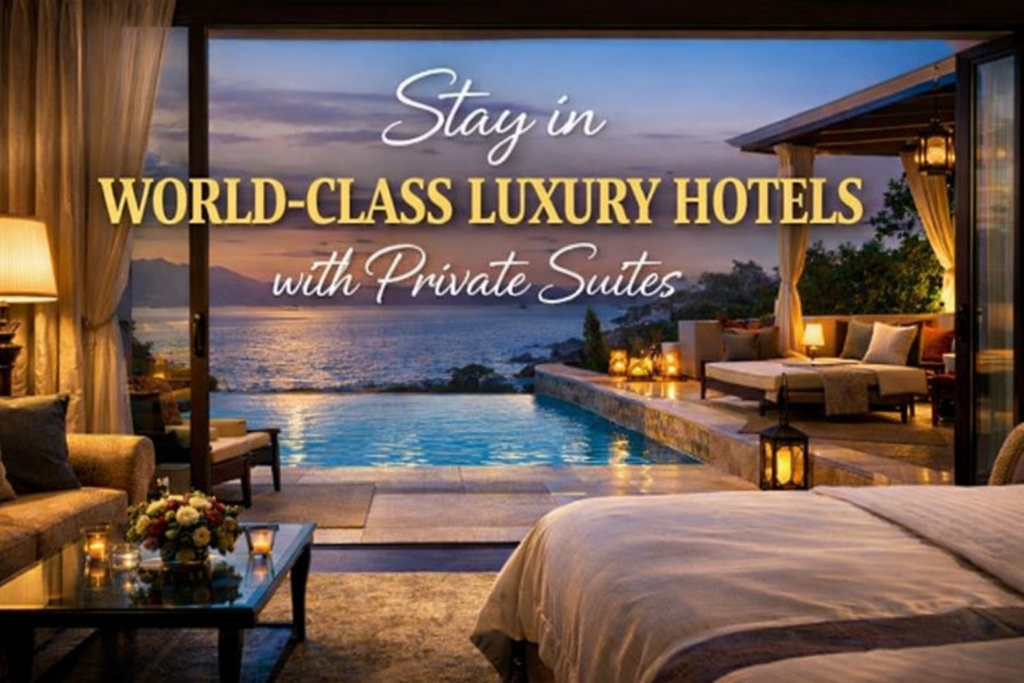
Stay in World-Class Luxury Hotels with Private Suites
Why Private-Suite Luxury Hotels Are Defining Modern Travel
(Stay in World-Class Luxury) Luxury travel has changed in a way that feels subtle on the surface but dramatic once you look closely. A decade ago, travelers chasing prestige often focused on famous names, marble lobbies, dramatic chandeliers, and a long list of visible amenities. Today, the center of gravity has shifted toward something more personal: privacy, space, custom service, and the feeling that a hotel stay has been shaped around one guest instead of a crowd. That shift is not guesswork. Virtuoso’s 2025 Luxe Report found ongoing appetite for higher-end travel, with advisors expecting demand and spending to rise, while travelers also became more deliberate about value and timing. Travel + Leisure’s 2025 survey, which drew nearly 180,000 readers and more than 657,000 votes, also showed that service, rooms, location, food, and value remain the pillars by which the world’s top hotels are judged.
So why are private suites now such a powerful selling point? Because they solve the biggest contradiction in modern luxury travel. Travelers want access to iconic cities, legendary resorts, and once-in-a-lifetime experiences, but they also want the emotional calm of a private residence. A great suite delivers both. It lets you stay in the center of Manhattan, Dubai, or the Maldives without feeling exposed to the pace, noise, or sameness that can make high-end travel feel oddly impersonal. The best suites act like insulated worlds. They create silence inside motion. They turn a hotel from a place where you sleep into a place where you actually live, recover, celebrate, work, reconnect, and breathe. That is why the luxury hotel suite has become less like a room category and more like a modern travel philosophy.
Privacy Has Become the New Status Symbol
In luxury hospitality, status used to shout. Now it whispers. The most desirable travelers increasingly want an experience that feels discreet rather than performative, and that is exactly where the private-suite model wins. A large suite with a terrace, a secluded villa with a pool, or a soundproof city retreat says something stronger than excess ever could: it says your time matters, your comfort matters, and your stay is being protected from interruption. Forbes Travel Guide’s methodology helps explain why this matters so much. Its current inspection framework emphasizes service and evaluates properties using hundreds of objective criteria, but it also highlights how an experience makes a guest feel. That emotional result is the entire game in top-tier luxury.
Think of privacy in a luxury suite like noise-canceling headphones for the entire travel experience. You may still be in the middle of a vibrant destination, but the friction gets removed. No crowded corridor energy, no sense of being processed, no feeling that you are sharing the same hotel script as everyone else. Aman New York leans directly into this idea by positioning its property as an urban sanctuary, with contemporary suites, fireplaces, deep soaking tubs, and substantial wellness space in the middle of Midtown. Soneva Jani does the same in a radically different setting, offering space and seclusion across low-density villas inside a vast private lagoon. Different geography, same promise: luxury is not only about what you can access, but also about what you can avoid.
Space, Silence, and Service Now Matter More Than Flash
There is a reason the best luxury properties keep returning to the same vocabulary: space, service, sense of place, and wellbeing. Forbes Travel Guide’s 2025 awards story says true luxury is not measured by thread counts or square footage alone, but by moments of genuine connection. That line lands because it captures what guests actually remember. They remember the concierge who anticipates a need before it is spoken. That remember the butler who notices whether they like morning light or blackout curtains. They remember that a suite felt like a refuge, not just a premium booking tier. Service turns a large room into an experience; without it, even a spectacular suite can feel like a showroom.
This is also why flashy design alone no longer guarantees that a property feels world-class. Beautiful surfaces are now the starting point, not the finish line. Modern luxury guests want intelligent layouts, wellness-led bathrooms, quiet acoustics, flexible dining, and a level of staff intuition that makes everything look effortless. Travel + Leisure readers still rate hotels on rooms and facilities, but they also weigh service and value. That balance matters. Travelers are not simply buying size; they are buying emotional ease. A private suite succeeds when it gives you the freedom of a residence, the polish of a legendary hotel, and the invisible support system of a team that knows when to appear and when to disappear. In other words, today’s finest suites do not just impress you. They protect your energy.
What Makes a Hotel Truly World-Class
A world-class luxury hotel is not just a property with a high rate and a famous address. That would be too easy. The phrase only means something when a hotel can perform at multiple levels at once. It needs strong design, yes, but also consistency. That needs a memorable location, but also real operational polish. It needs prestige, but also warmth. The best way to understand that standard is to look at how respected institutions judge hotels. Forbes Travel Guide says its anonymous inspectors assess hotels using up to 900 objective criteria, with service carrying particular importance. Travel + Leisure’s 2025 awards show what travelers themselves value most: rooms and facilities, location, service, food, and value. When those standards overlap, you get a practical definition of world-class. It is a hotel that excels both under expert scrutiny and in lived guest memory.
That is why a suite alone cannot carry a weak property. You can build a huge room, install expensive fixtures, and still fail if the overall stay feels fragmented. The arrival experience matters. The transfer arrangements matter. The quality of dining matters. The way a property responds when a guest changes plans matters. A true luxury hotel behaves like a finely tuned orchestra. The suite may be the violin solo everyone came to hear, but it only works because everything around it is in rhythm. This is where top brands and ranked properties stand apart. They are not selling isolated glamour. They are selling reliability at the highest level, which is much harder to build and much rarer to maintain.
Global Awards, Inspection Standards, and Reader Rankings
Awards matter in hospitality, but not all awards mean the same thing. Some are based on editorial review, some on guest voting, and some on inspection systems. The smartest travelers read across all three because each one reveals a different layer. Forbes Travel Guide’s current framework is valuable because it is structured and anonymous, with inspectors visiting properties and evaluating them against detailed criteria. Its 2025 list covered more than 2,100 properties in 90 countries, which gives it broad international weight. Travel + Leisure’s 2025 World’s Best Awards are useful for a different reason: they show what large numbers of engaged travelers actually loved, at scale. Nearly 180,000 readers participating is not a small whisper in the market; it is a roar.
What should you do with that information as a traveler? Use it the way an investor uses multiple signals before making a decision. Inspection-based recognition suggests quality control and operational depth. Reader-voted rankings suggest emotional resonance and repeat appeal. Brand rankings can signal whether a hotel company consistently delivers across destinations. Travel + Leisure’s 2025 brand ranking put Capella Hotels & Resorts first, followed by Oberoi, Regent, Shangri-La, and The Peninsula, while brands such as Aman, Four Seasons, Raffles, Six Senses, and Rosewood also remained in the top group. That does not mean every property is interchangeable, but it does tell you which names have built trust in the most competitive end of the market.
The Difference Between Five-Star Service and Real Luxury
People often use five-star and luxury as if they were identical, but they are not. Five-star can describe a high service category. Real luxury is a feeling created by thoughtfulness, timing, and individuality. A five-star hotel may give you formal service, elegant décor, and a strong amenity list. A true luxury hotel goes further. It gives you relevance. It understands why you are traveling and adjusts the stay around that purpose. That is why Forbes Travel Guide’s commentary about “moments of genuine connection” matters so much. It shifts the conversation from hardware to human experience.
This distinction is especially important when booking a private suite. You are not simply paying for more square meters. You are paying for a different style of living. The best suites work because the service around them is calibrated. Breakfast can arrive without drama. Housekeeping can operate invisibly. A last-minute dinner can feel seamless rather than negotiated. A late arrival after a long-haul flight can be met with calm efficiency instead of process-heavy formalities. In the end, real luxury feels less like being served and more like being understood. That is the difference between a hotel that photographs well and one that becomes part of your personal travel standards forever.
The Features That Turn a Suite into an Experience (Stay in World-Class Luxury)
A private suite becomes memorable when it stops behaving like a premium room and starts behaving like a complete environment. The strongest luxury suites are designed around flow. You do not just enter them; you settle into them. There is usually a deliberate separation between sleeping, lounging, dining, and wellness. The bathroom is not an afterthought but a sanctuary. Storage is smart. Lighting adapts to mood. Views are framed instead of merely exposed. This is why the best properties talk about suites with almost residential language. Aman New York highlights fireplaces, Japanese-inspired interiors, soaking tubs, and residential-style homes with open-plan living and dining. Soneva Jani emphasizes seclusion, one- to five-bedroom layouts, and private outdoor living anchored by water. These are not ordinary room upgrades. They are carefully staged lifestyles.
There is also a psychological side to suite design that people often underestimate. Space changes behavior. In a small room, you are always aware of function: where to set a bag, where to work, where to eat. In a large suite, behavior becomes more fluid. You read longer. You sleep better. That linger over room service instead of rushing out. You invite the destination in through a terrace, a fire-lit sitting room, or a panoramic view. Luxury hotels understand this. They are not just selling décor; they are shaping pace. A truly exceptional suite slows time the way a great piece of music seems to stretch a moment. You are still traveling, but you stop feeling hurried by travel. That is a rare and valuable transformation.
Signature Design, Wellness, and Residential Comfort (Stay in World-Class Luxury)
Luxury travelers now expect a suite to support the way they actually live. That means better sleep, more privacy, stronger wellness features, and a design language that feels coherent instead of generic. At Aman New York, the suite identity is tied to restraint, calm, and restorative comfort, supported by one of the city’s most ambitious wellness spaces at more than 25,000 square feet. At Soneva Jani, the wellness story merges with nature, low-density planning, and indoor-outdoor living. These examples show how different brands interpret the same goal: create a suite that does not feel like temporary accommodation, but like a place where your best habits become easier.
Residential comfort has become especially important because luxury travel is increasingly multifunctional. A guest may be on honeymoon, taking meetings, recovering from burnout, celebrating a birthday, and extending the trip for family time all in the same stay. That sounds extreme, but modern travel often blends purposes. A rigid room cannot support that. A good suite can. It gives you space to dine privately, work discreetly, rest deeply, and host selectively. It can feel like a city apartment, a private spa, and a boutique retreat at once. When a hotel gets this right, the suite becomes the emotional anchor of the trip. The destination may draw the booking, but the suite is what makes guests wish they had stayed longer.
Private Pools, Terraces, Fireplaces, and Personalized Touches (Stay in World-Class Luxury)
Nothing illustrates the evolution of luxury better than the rise of hyper-specific suite features. Travelers no longer react only to size; they react to how a suite enables a mood. A private pool creates freedom. A terrace creates breathing room. A functioning fireplace introduces ritual. A soaking tub becomes a reset button after a long flight. Aman New York explicitly highlights fireplaces and deep soaking tubs in its suite design, while some of its upper-floor homes include outdoor terraces and plunge pools. Soneva Jani’s villa collection leans into private pools, expansive decks, and immersive sea access, making the boundary between suite and landscape almost disappear.
These features matter because they shift the guest relationship from passive occupancy to active enjoyment. You do not just stay in the room; you use it as a stage for your day. You swim before breakfast. That read outside at sunset. You order dinner to the terrace instead of the restaurant because the suite feels better than any public venue. Personalized touches complete that picture. The right pillow menu, a tailored minibar, thoughtful airport transfer planning, quiet unpacking service, or dining adjusted to your schedule can make a suite feel astonishingly human. In great luxury hotels, personalization is not decoration. It is a kind of hospitality choreography, and when it is done well, it feels so natural you barely notice how much work is happening behind the curtain.
Best Destinations for Luxury Hotels with Private Suites (Stay in World-Class Luxury)
The best destination for a world-class luxury hotel with a private suite depends on the kind of privacy you want. Some travelers want urban insulation. They love being in New York, Paris, Tokyo, or Dubai, but they want a suite that shields them from the city when they are done exploring. Others want geographic seclusion: Maldives lagoons, desert landscapes, jungle canopies, or coastal estates where privacy is embedded into the environment itself. Both choices can be exceptional, but they satisfy different desires. Urban luxury is about contrast. Retreat luxury is about immersion. That is a useful way to frame your search.
The latest travel signals reinforce this split. Virtuoso’s 2025 Luxe Report highlights continued interest in personalized experiences, culinary discovery, wellness, cooler-climate alternatives, and more thoughtful trip timing. That suggests travelers are choosing suites not only for prestige, but for control. They want a hotel that fits the emotional tone of the trip. A celebratory city break may need skyline views, spa access, and private dining. A restorative island stay may need a pool, sea access, outdoor showers, and complete quiet. Luxury is becoming more intentional, and destination choice is now inseparable from suite choice. The best booking is not the most famous one. It is the one whose setting and accommodation style are in perfect alignment.
Urban Icons for Sophisticated City Stays
For travelers who love cities but hate feeling crowded, urban luxury hotels with serious suites are the sweet spot. Aman New York is a prime example because it frames itself as a sanctuary inside Midtown while offering unusually large suites, fireplace-led interiors, and extensive wellness facilities. The Mark, on Manhattan’s Upper East Side, brings a different energy: fashion, boldness, and residential glamour, reinforced by its place among The World’s 50 Best Hotels and its long-standing reputation for lavish suites. Burj Al Arab in Dubai represents another urban icon, one that leans into spectacle through its palatial duplex suites spread across two floors. Each of these properties proves the same point in a different accent: city luxury works best when the suite gives you emotional distance from the city’s intensity.
City suites are perfect for travelers who want dining, shopping, culture, and nightlife close at hand but do not want their private time to feel compromised. The right suite can transform a metropolis from something you endure into something you curate. You go out on your terms, then return to a controlled environment that feels deeply yours. That is especially powerful on short, high-value trips where every hour matters. When a suite is large enough to host breakfast, recovery time, and even informal meetings, the hotel becomes an extension of your itinerary rather than a pause between activities. In a top city hotel, the suite is not a retreat from the destination. It is your private command center within it.
Island, Desert, and Nature Escapes for Total Seclusion (Stay in World-Class Luxury)
When travelers picture total privacy, they usually imagine water, horizon, and distance. That is why island and nature-based luxury remains so magnetic. Soneva Jani captures that fantasy beautifully with low-density villas across a vast private lagoon, including residences with private pools and direct access to the water. In these settings, the suite is not merely attached to the destination; it is built from it. The view is not a bonus. It is the architecture’s main character. Every deck, pool, and open-air corner becomes part of the living space, which makes privacy feel expansive rather than enclosed.
These destinations are ideal for honeymoons, milestone trips, digital detoxes, and luxury family escapes where togetherness matters more than itinerary density. They also align with broader market trends. Virtuoso’s report points to wellness-oriented travel, shoulder-season planning, and more experience-led choices among affluent travelers. Nature retreats satisfy all three. They tend to encourage slower pacing, longer stays, and higher-value suite usage because guests actually spend time enjoying the accommodation itself. That matters. In an ordinary hotel, you might sleep in the room and spend the day elsewhere. In a great villa or private suite by the sea, the suite becomes part of the reason you traveled. It is both your destination and your shelter inside the destination, which is a very different kind of luxury.
Notable Luxury Hotels and Suites Worth Knowing (Stay in World-Class Luxury)
A shortlist helps turn inspiration into action, so here is a practical comparison of the kinds of properties that define luxury hotels with private suites today. The table below is not a universal ranking. It is a strategic lens for understanding different luxury personalities and what kind of traveler each one suits best.
| Hotel | Destination | Signature Private-Suite Appeal | Best For |
|---|---|---|---|
| Aman New York | New York City | Large contemporary suites, fireplaces, soaking tubs, strong wellness focus, urban sanctuary feel | Quiet luxury in a major city |
| Jumeirah Burj Al Arab | Dubai | Palatial duplex suites across two floors, iconic address, grand-service atmosphere | Statement stays and celebratory travel |
| The Mark | New York City | Lavish suite culture, Upper East Side setting, recognized among The World’s 50 Best Hotels | Fashion-forward city luxury |
| Soneva Jani | Maldives | Low-density villas, lagoon setting, private pools, seclusion, indoor-outdoor living | Honeymoons, privacy, restorative escapes |
Aman New York, Burj Al Arab, and The Mark (Stay in World-Class Luxury)
These three hotels show how the private-suite concept can stretch across very different definitions of luxury. Aman New York is for the traveler who wants stillness wrapped around a global city experience. The property emphasizes large suites, fireplaces, deep soaking tubs, and wellness at a scale rarely seen in Manhattan. Burj Al Arab is the opposite in tone but equally clear in identity. Its duplex suites are theatrical, vertical, and unmistakably grand, designed for travelers who want luxury to feel iconic and unapologetically visible. The Mark, meanwhile, balances polish and personality, leaning into Upper East Side sophistication and the social cachet of one of New York’s most recognizable luxury addresses.
What makes all three compelling is not that they look alike. They do not. What they share is confidence of purpose. Each one tells you exactly what kind of stay it wants to deliver. That clarity is incredibly useful when choosing a suite. Too many luxury bookings fail because travelers chase generic prestige instead of matching the hotel’s personality to their own intentions. Are you looking for calm, spectacle, or stylish intimacy? The answer changes everything. The best suite for one traveler could be completely wrong for another, even at the same price level. Luxury works best when fit matters more than hype. That may sound obvious, but it is one of the most expensive lessons in high-end travel.
Soneva Jani and Other Privacy-First Retreats (Stay in World-Class Luxury)
If the city-suite model is about insulation, the privacy-first retreat model is about immersion. Soneva Jani is a strong benchmark because it is built around space and seclusion from the start. The resort describes itself as one of the world’s lowest-density luxury resorts and offers one- to five-bedroom villas designed around water, horizon, and private living. That alone tells you what the stay is meant to feel like: unhurried, cinematic, and deeply personal. Suites and villas in this category often outperform traditional luxury rooms for travelers who want memorable time together rather than schedule-heavy sightseeing.
This category also benefits from current luxury-travel behavior. Travelers increasingly want experiences that feel transformative, restorative, and customized. Virtuoso’s 2025 findings around wellness, shoulder-season shifts, and more purposeful planning fit naturally with privacy-first resorts, where the room itself becomes part of the wellness equation. A private pool, natural light, ocean access, a large deck, and dining on your own schedule all reduce friction. That sounds simple, but simplicity is one of the hardest luxuries to create well. The best retreat suites make life feel spacious without ever becoming boring. They give you enough beauty to stay in, and enough service to make staying in feel like the smartest choice you made on the whole trip.
How to Choose the Right Private Suite for Your Travel Style (Stay in World-Class Luxury)
Choosing a luxury private suite should never begin with price alone. Start with purpose. Why are you taking this trip, really? Is it romance, recovery, celebration, business, family time, or a mix of all of them? Once you know that, the hotel decision becomes much sharper. A honeymoon suite should privilege privacy, mood, and uninterrupted time together. A family suite should prioritize layout, multi-bedroom flexibility, and outdoor space. A business-luxury stay needs quiet work zones, efficient service, and location logic. Travel + Leisure’s scoring framework is useful here because it reminds you to evaluate the whole picture: room quality, location, service, food, and value. In luxury travel, value does not mean “cheap.” It means “well matched to purpose.”
It also helps to think in trade-offs. A spectacular remote villa may give you absolute serenity, but less spontaneous access to city culture or shopping. A city icon may give you extraordinary convenience and dining, but less barefoot intimacy. One is not better than the other. They answer different emotional questions. The biggest booking mistake affluent travelers make is treating all luxury as equivalent. It is not. Some properties excel at romance, some at wellness, some at family logistics, some at cultural immersion, and some at all-out celebration. The suite is the tool. Your travel purpose is the blueprint. When those two line up, the money feels justified, the stay feels coherent, and the memories feel unusually complete.
Romantic Escapes, Family Travel, and Celebration Stays (Stay in World-Class Luxury)
Romantic trips usually need fewer distractions and better atmosphere. That means privacy, beautiful bathing spaces, terraces, discreet dining, and a layout that encourages lingering rather than constant movement. Family luxury, on the other hand, rewards practicality dressed as elegance. Multiple bedrooms, shared living areas, outdoor zones, and enough separation for adults and children to coexist happily are far more important than decorative drama. Celebration stays live somewhere in between. They need a suite that can host a moment, whether that means champagne on a skyline terrace, private dinner service, or simply the emotional wow factor of checking into something legendary.
This is where researching suite specifics pays off. Burj Al Arab’s duplex style creates natural theatre for a celebration. Soneva Jani’s larger villas are ideal for families or groups who want shared luxury without losing privacy. Aman New York’s calm, design-led suites are ideal for couples or travelers who want restorative intimacy in the middle of a dynamic city. The right choice is less about chasing the most famous suite and more about understanding how the suite supports the story of your trip. A great luxury booking should feel like the setting was written into the occasion from the very beginning. When that happens, the suite stops feeling like accommodation and starts feeling like part of the memory itself.
Wellness Trips, Business-Luxury Blends, and Long Stays (Stay in World-Class Luxury)
Wellness travel is no longer a niche lane inside luxury hospitality. It is one of the main highways. Virtuoso’s 2025 report points to ongoing demand for softer adventure, restorative experiences, and more thoughtful seasonal travel. That trend has obvious implications for suites. Travelers on wellness-led stays need quiet, good sleep conditions, strong bathrooms, flexible dining, and enough space for a slower rhythm. Aman New York’s substantial wellness offering makes it especially relevant here, while retreat properties like Soneva Jani naturally support reset-style travel through setting alone.
Business-luxury blends and longer stays also favor suites over standard rooms because the suite absorbs complexity better. A standard room can feel efficient for one night. On day three, it often feels restrictive. A suite gives you zones for calls, work, meals, and rest, which means the trip retains dignity instead of turning into endurance. This matters even more for travelers who extend business trips into leisure stays or bring a partner along. The suite becomes a bridge between functions. It lets one person work without trapping the other in the same compressed space. It lets the trip evolve. And that, quietly, may be the strongest argument for private-suite luxury of all: the best suites are not just more comfortable. They are more adaptable to real life.
Conclusion (Stay in World-Class Luxury)
Staying in world-class luxury hotels with private suites is no longer just about indulgence. It is about choosing a travel environment that matches how sophisticated travelers actually want to live now: with more control, more calm, better service, stronger design, and a deeper sense of personal space. Fresh industry signals show that affluent travel continues to lean toward customized experiences, smarter value decisions, wellness, and meaningful quality. At the same time, major award systems and reader rankings keep reinforcing the same idea: the best hotels win not only because they are beautiful, but because they make guests feel understood.
That is why the best private suites feel so powerful. They solve the tension at the heart of modern travel. They let you be in the world without being overwhelmed by it. In a top city hotel, a suite can feel like your own hidden residence above the noise. In a destination resort, it can feel like a private universe where the landscape becomes part of your living room. Whether you choose the quiet precision of Aman New York, the dramatic grandeur of Burj Al Arab, the polished charisma of The Mark, or the floating serenity of Soneva Jani, the goal is the same: find a stay where privacy, place, and service meet in the right proportions for your life. That is what real luxury looks like now.