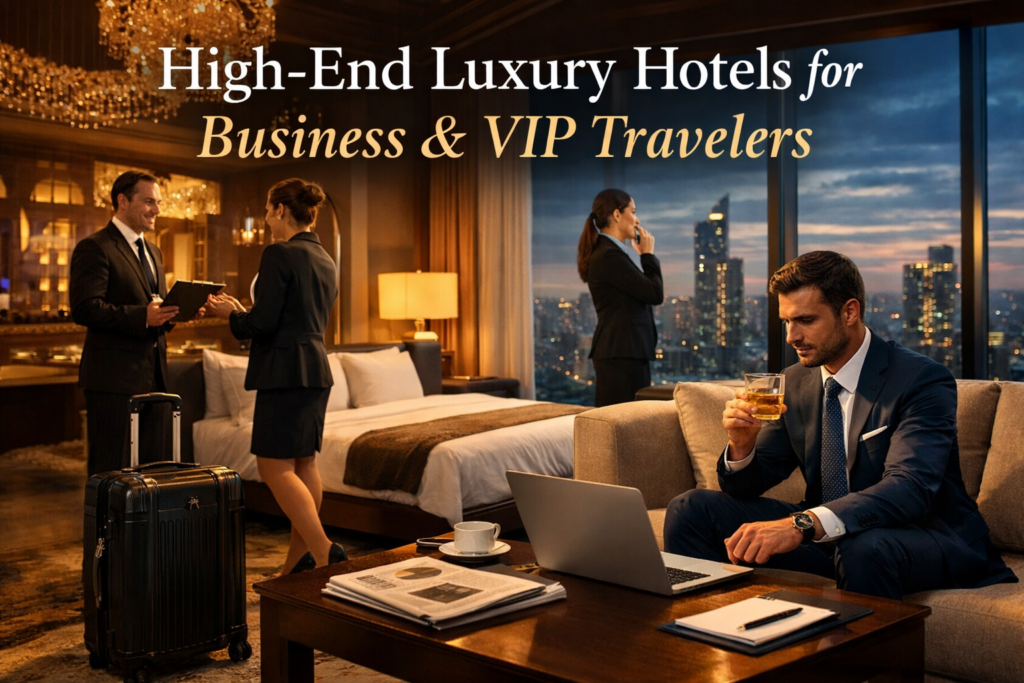
Why Luxury Business Travel Still Matters in 2026
(High-End Luxury Hotels) Luxury business travel is not some outdated executive indulgence. It is a strategic tool, and the numbers back that up. GBTA projects global business travel spending to reach $1.57 trillion in 2025, with continued growth expected after that, even though companies are watching costs more carefully and dealing with economic uncertainty. That matters because it shows something important: organizations still believe in face-to-face meetings, high-stakes negotiations, investor roadshows, leadership summits, and client entertainment. When the trip carries pressure, reputation, and deal value, the hotel becomes more than a place to sleep.
It becomes the private office, the secure meeting zone, the decompression chamber, and sometimes the stage on which business credibility is quietly judged. A luxury hotel that gets this right creates time, calm, and confidence for the traveler. A hotel that gets it wrong creates friction at exactly the moment an executive cannot afford friction. That is why the high-end hotel segment remains highly relevant for business travelers, VIP guests, and companies that care about performance as much as polish. GBTA also reports that 86% of business travelers say their trips are worthwhile, which reinforces the idea that premium corporate travel remains tied to real outcomes, not vanity.
The meaning of luxury has also shifted. A decade ago, many travelers judged a hotel by marble lobbies, oversized chandeliers, and a dramatic penthouse view. Those details still help, but they no longer define the full experience for elite business guests. Forbes Travel Guide’s 2025 awards coverage makes that point sharply when it says that true luxury is about “moments of genuine connection,” not just room size or finishes. Its inspectors place heavy weight on service quality, with 70% of a property’s rating tied to service rather than facilities alone.
What Defines a True High-End Business Hotel
(High-End Luxury Hotels) A real high-end business hotel is built around precision. It understands that an executive guest may land after a red-eye flight, head straight into a board meeting, need secure Wi-Fi strong enough for simultaneous video calls, expect immediate luggage delivery, and then require a discreet dinner arrangement for a sensitive client conversation. This is where luxury and utility finally meet. J.D. Power’s 2025 hotel guest satisfaction study highlights the dimensions that shape satisfaction today: check-in/check-out, connectivity, facilities, food and beverage, guest room, staff service, and value. That mix is revealing because it confirms that the premium guest experience is operational, not decorative.
Even more telling, guests who use a hotel’s app score satisfaction 68 points higher than those who do not. That suggests high-end travelers increasingly value convenience that feels seamless and self-directed. Still, technology alone is not enough. The top luxury hotels combine fast systems with staff who know when to step in quietly and solve a problem before it becomes visible. Think of it like a fine mechanical watch: the outside matters, but the real value lives in the movement inside. For VIP travelers, the best hotels are the ones where nothing feels accidental.
The strongest business hotels also treat privacy like a premium amenity. That means controlled access, soundproof rooms, discreet elevators when possible, secure payment handling, minimal lobby chaos, and staff trained to serve visible high-profile guests without turning them into a spectacle. This matters more than ever because many VIP travelers are balancing public visibility with business confidentiality.
What Executive Travelers Actually Value Most
(High-End Luxury Hotels) Ask a frequent corporate flyer what matters most, and you will rarely hear a speech about decorative pillows. You will hear about time, access, control, and sleep. That is why location remains one of the most important decision factors for high-end business hotels. A luxury property near a financial district, major convention venue, embassy area, or private aviation corridor can easily outperform a more glamorous resort-style hotel that simply sits too far from the action. Business travelers also care about fast car service, reliable airport transfers, strong in-room workspaces, and meeting-friendly food service schedules. J.D.
Power’s 2025 study shows that investments in guest room furnishings, bathroom condition, and bed comfort are directly improving satisfaction. That is not surprising. For a CEO, diplomat, or investor, the room has to function as a recovery suite and a working studio at the same time. A good mattress becomes a performance tool. A quiet HVAC system becomes a cognitive advantage. A spacious desk with convenient charging becomes part of deal preparation. The best luxury hotels understand this and design their rooms like executive instruments rather than generic guest spaces.
Lounge access, suite configuration, and staff discretion also rank high for premium guests because these features create control over the rhythm of the trip. An executive lounge is not just a perk. It is a buffer. It offers a quieter environment for quick meetings, private breakfasts, last-minute calls, and decompression between obligations.
Why Personalized Service Is the New Luxury Standard (High-End Luxury Hotels)
The old model of luxury hospitality was reactive. The guest asked, and the hotel delivered. The new model is anticipatory. The best luxury business hotels study preference patterns, travel context, and stay purpose well enough to act before the request becomes necessary. This is where real differentiation happens. Forbes Travel Guide’s 2025 coverage paints a vivid picture of this standard through examples like concierges who find local gems, chefs who source with intention, and spa teams that customize treatments. That same logic applies to business hospitality.
A top-tier hotel should recognize that a VIP traveler arriving from an overnight international flight may need faster room readiness, simplified meal options, pressing service, and a meeting setup that avoids unnecessary back-and-forth. The experience should feel custom without feeling invasive. It should feel attentive without becoming theatrical. That balance is hard to achieve, which is exactly why it defines luxury. Anyone can offer champagne at check-in. Far fewer can coordinate five invisible details that save a guest thirty valuable minutes before a major presentation.
Personalization also works because modern guests are more willing to trade selected data for a better stay when the value is obvious. According to a 2025 Mews-commissioned survey, 93% of travelers said they would share personal data to improve hotel experiences, including preferences around check-in times, amenities, and food choices. That does not mean every hotel should over-collect data or become intrusive. It means the smartest luxury operators now have permission to be more relevant, as long as they are also trustworthy.
The Role of AI, Apps, and Contactless Convenience (High-End Luxury Hotels)
Technology is reshaping luxury hospitality, but the best hotels use it like stage lighting, not like the show itself. Guests notice the smoothness, not the machinery. Marriott’s 2025 Annual Report makes clear that the company is modernizing core systems and positioning itself to leverage AI more effectively across the guest journey. J.D. Power’s 2025 findings support the business case: hotel guests with the hotel app installed report significantly higher satisfaction. A separate 2025 survey commissioned by Mews found that 70% of American travelers would likely use an app or kiosk instead of a traditional front desk, and that 82% of current loyalty members report pain points with outdated hotel systems.
Put those findings together and the message becomes obvious. Premium travelers increasingly want technology to remove repetitive, low-value moments from the stay. They want digital check-in, digital keys, instant folios, fast preference updates, and fewer administrative interruptions. For business guests rushing between meetings, this is not a novelty. It is a competitive advantage. Every minute recovered from a clumsy arrival process can be used for actual work, rest, or relationship building.
Still, there is a line that luxury hotels must not cross. Tech should reduce friction, not replace hospitality. When a VIP traveler needs help with security, last-minute itinerary changes, or a sensitive guest request, no kiosk can replace a composed, well-trained human being. The winning formula is hybrid. Use apps for speed. Use people for judgment. That is why luxury hospitality is moving toward what you might call invisible intelligence. The check-in process gets shorter, but the welcome feels warmer. The app handles routine tasks, while staff focus on the moments that require emotional intelligence, diplomacy, or taste.
Best Luxury Hotel Brands for Business and VIP Stays (High-End Luxury Hotels)
Some brands consistently stand out because they understand both luxury signaling and business functionality. The Ritz-Carlton is one of the clearest examples. J.D. Power ranked it highest in the Luxury segment in its 2025 North America Hotel Guest Satisfaction Index, giving it a score of 779. That ranking matters because it reflects not just brand aura, but measurable satisfaction across the operating dimensions that business guests actually feel during a stay.
Ritz-Carlton properties typically work well for executives because the brand pairs formal service culture with polished meeting capability and strong recognition standards. The same conversation often includes The Luxury Collection, which appeals to VIP travelers who want a stronger sense of place without giving up premium service expectations. Then there are flagship Hilton luxury brands like Waldorf Astoria and Conrad, which continue to benefit from Hilton’s scale and innovation push, while catering to travelers who want elegance with modern convenience. In practice, the best brand depends on the mission of the trip. Some stays call for classic gravitas. Others call for contemporary efficiency with softer lifestyle touches. The smart move is matching the brand personality to the business objective.
Brand ecosystem strength matters almost as much as the individual property because executive travel is rarely a one-off event. It is a pattern repeated across cities, quarters, and regions. Marriott’s global footprint, expanding development pipeline, and enormous loyalty base give it real advantages for travelers who need dependable premium options across major commercial markets. Hilton’s portfolio scale is also substantial, with more than 9,100 properties and over 1.3 million rooms in 143 countries and territories, according to its 2025 trends material. That kind of network matters because VIP travelers often need continuity, not just luxury.
Wellness, Discretion, and Bleisure Now Belong in the Same Trip (High-End Luxury Hotels)
Business travel used to celebrate endurance. The ideal executive was expected to fly overnight, power through meetings, eat whatever was available, and treat exhaustion like a badge of honor. That mindset is fading, and premium hotels are adapting fast. Forbes Travel Guide’s 2025 perspective explicitly notes that top properties are evaluated on whether they help guests maintain a health-conscious lifestyle and support well-being.
That is a major shift. It means a serious luxury business hotel now needs more than a generic gym. It needs useful wellness design: quality sleep environments, healthy dining choices available on real business schedules, spa recovery options, fitness spaces that feel credible, and environments calm enough to restore focus. This is especially relevant for VIP travelers managing public attention, jet lag, and heavy decision-making. A hotel that helps a guest feel sharp on day three of a high-pressure trip has delivered real value. Wellness is not fluff in this context. It is operational readiness packaged as hospitality.
The rise of bleisure also fits naturally into the luxury business segment. Business travelers increasingly want their work trips to feel less transactional and more human, especially when they are already spending significant time away from home. GBTA’s 2025 outlook says average trip spending rose to $1,128, up from $834 in the prior survey, which suggests travelers and companies are already navigating higher-value trips. That makes it easier to understand why many premium travelers look for stays that combine work utility with lifestyle payoff. A luxury hotel that offers efficient workspaces, strong meeting support, excellent dining, and an authentic local experience becomes more attractive than one that only performs in one category.
How to Choose the Right Luxury Hotel for Executive Travel (High-End Luxury Hotels)
Choosing the right hotel starts with one simple question: what is this trip really for? If the goal is a board meeting, the best choice may be a polished city property with discreet meeting rooms, fast transfers, and airtight service discipline. That the goal is investor entertainment or relationship building, a hotel with stronger dining, lounge, and cultural credentials may outperform a more conventional business tower. If the traveler is a public figure or a security-sensitive executive, privacy protocols and controlled access may outrank all other features.
This is why smart bookers avoid choosing luxury hotels based only on star rating or social media appeal. Ratings matter, and sources like Forbes Travel Guide and J.D. Power are genuinely useful, but the real decision should align the hotel’s strengths with the purpose of the stay. Think of the booking process like choosing a suit. The best suit is not the most expensive one hanging in the store. It is the one tailored for the specific room you are about to walk into. Luxury business travel works exactly the same way.
A practical checklist helps. Before booking a high-end hotel for a business or VIP trip, verify the following: distance to the key venue at the relevant time of day, airport transfer quality, room layout for actual work, club or lounge value, meeting and dining flexibility, mobile app usability, loyalty recognition likelihood, and privacy/security fit. It also helps to scan fresh brand signals. Marriott’s continued investment in technology and loyalty suggests strong upside for repeat executive travelers, while Hilton’s ongoing innovation push reflects how seriously major operators are taking traveler expectations. If guest experience benchmarks matter heavily in your decision, J.D. Power’s rankings and satisfaction drivers offer a helpful reality check.
Conclusion (High-End Luxury Hotels)
High-end luxury hotels for business and VIP travelers are no longer defined by decoration alone. They are defined by how effectively they support performance, privacy, comfort, and trust. The strongest properties understand that executive travel is full of pressure points, and every detail of the stay either removes stress or adds to it. Fresh 2025 data points in the same direction: global business-travel demand remains strong, app-enabled convenience raises satisfaction, and service quality still sits at the heart of genuine luxury.
That combination is reshaping the premium hotel market. The best business hotels now behave like elegant operating systems. They are beautiful, yes, but they are also responsive, intelligent, discreet, and deeply practical. For companies, assistants, and travelers making high-stakes bookings, that is the real goal. Choose the hotel that protects time, supports focus, and makes the guest feel both powerful and at ease. That is where modern luxury travel, business hospitality, and VIP service truly meet.