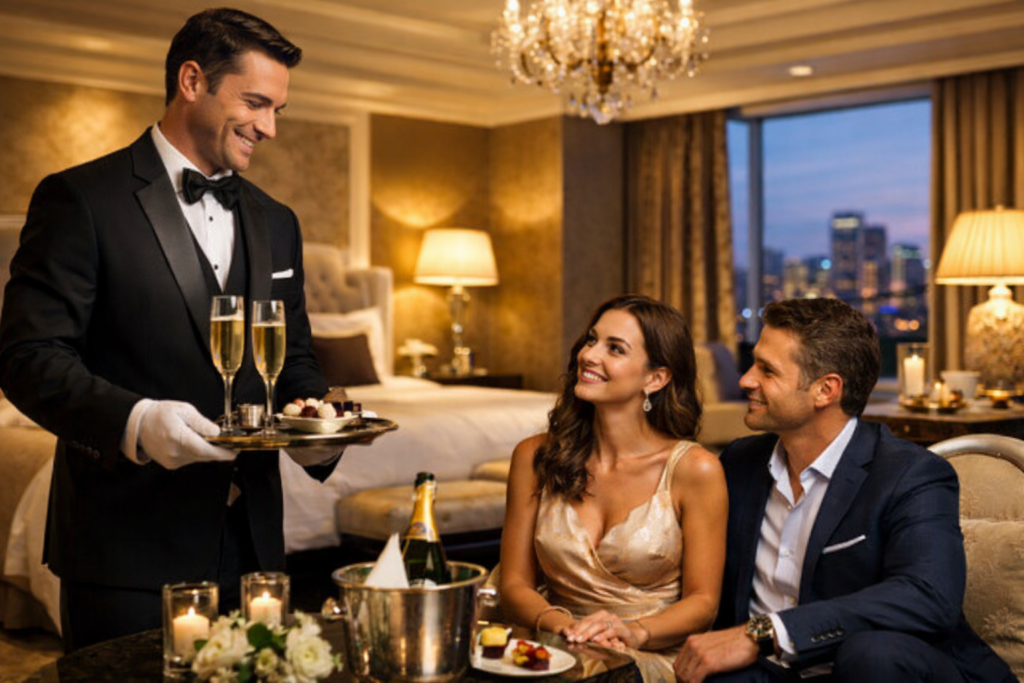
Premium Hotel Suites with Private Butler Service
(Premium Hotel Suites) A premium hotel suite with private butler service is no longer just a glamorous fantasy pulled from old-world luxury movies. It has become one of the clearest symbols of where luxury hospitality, high-end travel, and personalized hotel service are heading right now. The reason is simple: affluent travelers are spending more, expecting more, and judging premium stays less by marble and chandeliers alone and more by how seamlessly a hotel understands them. Current market research shows the global luxury hotel market was estimated at USD 110.87 billion in 2025 and is projected to reach USD 196.70 billion by 2033, while the broader luxury travel market reached USD 1.59 trillion in 2025 and is forecast to hit USD 3.04 trillion by 2033.
Those numbers matter because they show a strong commercial shift toward higher-value, experience-led travel rather than simple room selling. At the same time, ultra-luxury traveler research indicates wellness, personalization, and effortless experiences are shaping booking decisions, with 80% of surveyed ultra-luxury travelers increasing their travel budgets. Put all of that together, and the rise of the private butler suite starts to make perfect sense: travelers are paying for a smoother life, not just a larger room.
Why This Luxury Stay Category Matters More in 2026
Luxury used to be easy to fake. A giant lobby, polished brass, imported stone, and a room rate high enough to make guests assume excellence was built in. That model still exists, but it no longer wins on its own. Today’s premium guest is not simply asking, “How beautiful is this suite?” The better question is, “How intelligently does this hotel remove friction from my day?” That is where private butler service changes the entire equation. In a strong luxury property, a butler is not a decorative extra.
A butler is an operating system for comfort. Research on the luxury travel market now explicitly highlights personalized services, exclusivity, and professional staff interaction as core benchmarks of luxury travel, while Virtuoso’s 2025 findings show travelers still prioritize personalized experiences but want stronger value from every dollar spent. This means modern luxury is becoming more precise and more demanding. Guests want privacy, but they also want speed. They want warmth, but not intrusion. They want every detail handled, yet they never want to feel handled. A great butler-led suite stay achieves that balance like a perfectly tuned orchestra: invisible structure, visible ease, and no wasted movement.
Luxury hotel market growth is accelerating
The demand story is not vague or theoretical. It is backed by current market data pointing to stronger growth in business hotels, direct bookings, and wellness-oriented premium stays. Grand View Research identifies business hotels as the largest type segment in 2025, and luxury resorts and spas are also projected to grow strongly as travelers increasingly seek integrated wellbeing and structured premium experiences. Asia Pacific is identified as the fastest-growing region in the luxury hotel market, which is especially relevant because many of the world’s most competitive service-led luxury properties are in Asia and the Middle East, where the standards for human attention are exceptionally high.
That regional growth matters for this article because premium suites with butler service thrive where service culture is treated as a core product rather than a supporting department. In other words, the market is not only expanding; it is rewarding hotels that can combine physical grandeur with emotionally intelligent service. The room may get the click, but service gets the repeat booking.
Personalization is now the real definition of premium
A butler-led suite stay is the hotel version of having a brilliant producer behind the scenes. You may not see every decision being made, but the result feels frictionless. Flywire’s 2025 ultra-luxury traveler findings reinforce this shift by showing that wellness, personalization, and effortless experiences are driving decision-making, while Visa’s 2025 affluent travel research also found that wealthier travelers are leaning toward personalized, off-the-beaten-path experiences.
That tells us something important: luxury is becoming less about static prestige and more about adaptive relevance. Guests do not just want fresh flowers, premium linens, and expensive champagne. They want the room temperature remembered, unpacking handled, tea brought exactly when they return from a spa treatment, transportation aligned with their dinner plans, and privacy protected without them having to repeat themselves. That is why a premium suite without refined service can feel like a showroom, while a slightly less flashy suite with a skilled butler can feel unforgettable. The butler turns hardware into hospitality.
What Private Butler Service Really Means
The phrase private butler service gets used loosely in travel marketing, so it is worth being precise. In the best luxury hotels, a butler is not just someone who answers a phone line quickly. A real hotel butler works as a dedicated service specialist focused on anticipation, personalization, in-suite convenience, and discreet coordination. Officially, St. Regis describes its butler program as a signature offering that has existed for more than a century, centered on anticipatory, personalized service across more than 40 hotels and resorts worldwide.
The brand’s own service descriptions include unpacking and packing assistance, beverage delivery, garment pressing, and round-the-clock access through the Butler Service Desk. That operational detail is useful because it shows what separates substance from branding. A serious butler program is process-based. It is built into the property’s service design, not improvised after check-in. When travelers pay for a luxury suite with butler, they are really paying for time savings, emotional ease, and a reduction in travel friction. That is the hidden currency of ultra-premium hospitality.
Core butler duties inside a premium suite
In practical terms, a skilled butler handles the small moments that quietly define a stay. That may include unpacking luggage, pressing garments, delivering coffee or tea on schedule, coordinating wake-up rituals, arranging in-suite dining, supporting special celebrations, managing last-minute changes, and serving as a rapid-response point of contact for complex guest needs. St. Regis explicitly lists unpacking, packing, beverage service, garment pressing, and 24-hour access by desk, email, and text as part of its butler ecosystem.
Raffles goes in a slightly different direction by framing the butler as the architect of a suite experience, often bundling services such as airport transfers, daily breakfast, champagne, spa treatments, club access, and 24-hour Raffles Butler Service into suite packages. That blend of ritual and responsiveness is what makes the concept so powerful. The guest is not forced to navigate multiple departments. The stay feels centralized, simplified, and deeply personal. Like a great stage manager in a live performance, the butler makes complexity disappear before the audience even notices it existed.
The difference between a butler and a concierge
Many travelers confuse butler service with concierge service, but they serve different functions. A concierge typically works at a broader destination level, helping with restaurant reservations, transportation, tickets, local recommendations, and off-property experiences. A butler, by contrast, is more intimately tied to the room, the guest’s personal rhythms, and the immediate quality of the stay itself. Think of the concierge as a city navigator and the butler as a lifestyle conductor. In a premium suite, that distinction matters because the guest is not only buying access to the destination.
They are buying control over how their time feels. A concierge can secure the table. A butler can make sure you return from dinner to the right tea, the right lighting, pressed evening wear, and tomorrow’s plans already aligned. That difference turns luxury accommodation into luxury living, even if only for a few nights. Official examples from brands like St. Regis, Raffles, and Four Seasons show how deeply service now extends into the in-suite experience itself.
What Makes a Suite Truly Premium
A premium hotel suite is not simply a bigger guest room with a better view. Size matters, but it is only the outer shell. True premium status comes from how well space, privacy, design, service access, and functional comfort work together. The best suites act like a private residence with hotel-grade precision. They separate sleeping, entertaining, dining, and working zones. That create a sense of arrival rather than just entry.
They protect quiet. They allow both intimacy and performance, whether the guest is hosting a family dinner, taking a confidential business call, or celebrating a milestone birthday. Four Seasons Jakarta’s 2025 presidential suite release captures this modern expectation well by emphasizing tailored spaces that can shift from restful retreat to confidential meeting venue to private celebration setting, all elevated through private butler service. That flexibility is a major part of premium value. A suite should not force the guest to adapt to the room. The room should adapt to the guest.
Space, privacy, design, and arrival experience
The first test of a premium suite is psychological. Does the suite make the guest exhale? Does it feel expansive without being cold, polished without being sterile, and impressive without looking like it is trying too hard? The strongest properties understand that luxury design is really about emotional choreography. Entry should feel calm. Storage should feel intuitive. Bathrooms should feel ceremonial. Bedding should feel sanctuary-level rather than merely expensive. In many top-tier hotels, premium suites also include private check-in options, lounge or club access, airport transfers, or highly curated arrival rituals.
Raffles Jakarta’s suite offer, for example, ties its suite category to Raffles Club access, spa treatments, airport limousine transfers, and 24-hour butler service, which shows how premium positioning is increasingly built around a bundled ecosystem rather than square footage alone. That is an important SEO insight for luxury hospitality content too: the highest-value guest is searching for complete experience packages, not isolated room features.
In-suite technology, wellness, and tailored comfort (Premium Hotel Suites)
Modern premium suites are also becoming more wellness-aware and more adaptive. Industry trend reporting points to strong growth in wellness-oriented luxury travel and rising guest expectations for highly personalized environments. That means premium suites now compete on sleep quality, lighting control, bath rituals, privacy management, sound insulation, air quality, and in some cases smart customization. Even when a hotel does not advertise every technical detail, the service model increasingly supports seamless comfort adjustments through attentive staff and butler-led coordination. This is where the human layer remains decisive. Technology can dim the lights, but a butler understands context. Technology can automate climate settings, but a butler notices that you came back from dinner tired, draws the curtains, places tea at the right time, and prevents the room from feeling machine-managed. The future of ultra-luxury is not human versus tech. It is human judgment supported by better systems.
Who Benefits Most from Butler-Led Suite Stays (Premium Hotel Suites)
The obvious audience for a hotel suite with private butler is the luxury leisure traveler, but the category is broader than that. Couples booking honeymoons, anniversaries, and proposal trips value the privacy, romance, and stress reduction. Families value flexibility and extra hands. Executives value control, speed, and discretion. Public figures value privacy and invisible logistics. Multi-generational travelers value coordination. That range is one reason the category keeps growing. The suite becomes a platform that can shift roles throughout the day: breakfast lounge in the morning, remote office by noon, celebration venue at night. Grand View Research also notes that business hotels hold the largest share within the luxury hotel market, which reinforces the idea that premium service is not only a holiday indulgence. It is also a performance tool for people whose schedules, privacy needs, or status create unusually high service friction.
Couples, celebratory travelers, and leisure guests
For leisure travelers, the appeal is emotional as much as practical. A butler-led suite stay creates a feeling that the trip is unfolding around you rather than demanding constant management from you. That matters deeply on anniversary escapes, honeymoon stays, and milestone celebrations, where the emotional tone of the trip is often more important than the itinerary itself. Raffles positions its suite experiences around that sense of tailored memory-making, while St. Regis has long treated butler service as a signature ritual rather than a simple add-on. The guest is not just purchasing comfort; they are purchasing fewer interruptions, fewer missed moments, and fewer logistical tasks clogging up the emotional flow of the trip. A beautifully run luxury stay should feel like a river, not a traffic jam. Butler service keeps the current moving.
Business travelers, VIPs, and families (Premium Hotel Suites)
The business and VIP case may be even stronger. Four Seasons Jakarta’s current positioning of its presidential suite highlights confidential meetings, gourmet family gatherings, and intimate events supported by private butler service. That is a sharp illustration of how the premium suite has evolved into a hybrid space for business travel, executive hospitality, and private entertaining. For VIP travelers, the benefit is obvious: fewer touchpoints, stronger discretion, and quicker problem resolution. For families, a butler can reduce the invisible labor that usually falls on parents during a trip. That may sound small until you realize that premium hospitality is often about removing the thousand tiny tasks that quietly drain a stay. The luxury is not just in what is added. It is in what is taken off your shoulders.
How Leading Hotel Brands Deliver Butler Excellence (Premium Hotel Suites)
The fastest way to understand the category is to look at how major luxury brands present it today.
| Brand | Current official service positioning | Notable suite-related details |
|---|---|---|
| St. Regis | Butler service described as a signature offering with more than a century of history and anticipatory personalized care | Unpacking, packing, beverage service, garment pressing, 24-hour access by desk, email, or text |
| Raffles | Butler-led suite stays designed around discreet personalization and curated perks | Champagne, breakfast, spa treatments, airport transfers, club access, 24-hour butler service in select offers |
| Four Seasons | Private butler service framed as part of modern ultra-suite personalization | Tailored support for private stays, VIP events, meetings, and celebrations in the presidential suite context |
| Forbes Travel Guide example | Independent luxury guide highlights butler service as a key differentiator in top-tier properties | St. Regis Macao noted for 24-hour personalized service and distinction within its market |
St. Regis and the legacy of anticipatory service (Premium Hotel Suites)
That wording matters. Anticipation is much harder than reaction. Anyone can respond to a request. The highest level of service predicts what the guest will want before the request becomes necessary. That is one reason St. Regis remains closely associated with butler-led luxury in traveler perception and editorial coverage. When Forbes Travel Guide reviewed The St. Regis Macao, it specifically emphasized the property’s 24-hour personalized service as a differentiator. In SEO terms, that creates a powerful keyword cluster around luxury suite service, butler hotel experience, 24-hour personalized hotel service, and premium hospitality excellence. In guest terms, it creates trust.
Raffles and the art of discreet personalization
Raffles approaches the concept with a slightly different emotional texture. The brand leans into refinement, ritual, and a kind of quiet theatricality. Its official butler-led suite offers combine practical perks with a strong narrative of individualized care, often layering in breakfast, spa treatments, transfers, and club access. The Jakarta suite offer is especially instructive because it makes the value proposition tangible: the butler is not abstract branding but part of an integrated stay design. That design is what today’s luxury traveler increasingly expects. Virtuoso’s 2025 research shows travelers still seek quality but are also more value-conscious, which means hotels must justify premium pricing through visible usefulness, not just reputation. Raffles does that by turning service into a full-package experience rather than a vague promise.
Four Seasons and the modern ultra-suite model (Premium Hotel Suites)
Four Seasons, meanwhile, shows where the category is heading next. Its 2025 Jakarta presidential suite messaging presents private butler service not only as a convenience layer but as an enabler of multiple premium use cases, from confidential meetings to last-minute VIP events and intimate celebrations. That is a very modern framing. It reflects the blurring lines between luxury travel, business hospitality, and private residential-style stays. Premium suites are no longer just places to sleep well. They are places to host, negotiate, celebrate, recover, and work privately. The butler becomes the human interface that keeps those functions from colliding. That model is likely to grow because it aligns with broader market demand for adaptive, flexible, high-touch luxury.
How to Book Smart and Get Real Value (Premium Hotel Suites)
Is it a real service system with clear touchpoints, or just an upscale phrase used loosely in marketing? Official brand pages are very helpful here because they often spell out operational details. Fourth, consider the purpose of your trip. If you are planning a honeymoon, celebration, or privacy-sensitive business stay, the value of personalized coordination may far exceed the extra room cost. If you only need a beautiful room for one quick night, the premium may be unnecessary. The smartest booking is not the most expensive option. It is the one where the service design fits the reason you are traveling.
Conclusion (Premium Hotel Suites)
The market is moving in one clear direction: premium hospitality is becoming more personal, more seamless, and more service-led. Current data shows luxury travel and luxury hotels both expanding strongly, while research on affluent and ultra-luxury travelers points to the same core demand signals again and again: personalization, wellness, ease, exclusivity, and value without compromise.
That is exactly why premium hotel suites with private butler service are gaining relevance. They answer the modern luxury traveler’s real question, which is not simply, “How expensive is this stay?” but rather, “How beautifully does this stay take care of me?” The best butler-led suite experiences do not just look premium. That feel intelligent. They preserve time, reduce friction, protect privacy, and transform a hotel from a place you visit into a place that briefly seems to understand you. In the end, that is the highest form of luxury: not excess for its own sake, but elegance that works.