Why Executive Business Travel Still Matters in 2025
(Best Luxury Hotels) The easiest mistake to make in 2026 is assuming that video calls replaced the need for premium corporate travel. They did not. They filtered it. Today, companies are more selective, which means the trips that remain tend to be more strategic, more expensive, and more closely tied to outcomes. Senior leaders are not flying across continents for routine check-ins. They are traveling for investor roadshows, deal negotiations, client retention, regulatory engagement, expansion planning, board meetings, and leadership alignment. That is why the luxury hotel category matters so much in business travel now.
The trip itself has become more valuable, so the environment supporting that trip has to match the stakes. GBTA’s 2025 forecast shows the industry still growing, with the U.S. projected as the top business travel market, followed by China, Germany, Japan, and the UK. That concentration matters because it maps closely to cities where executive travelers demand reliable luxury inventory and premium hotel ecosystems.
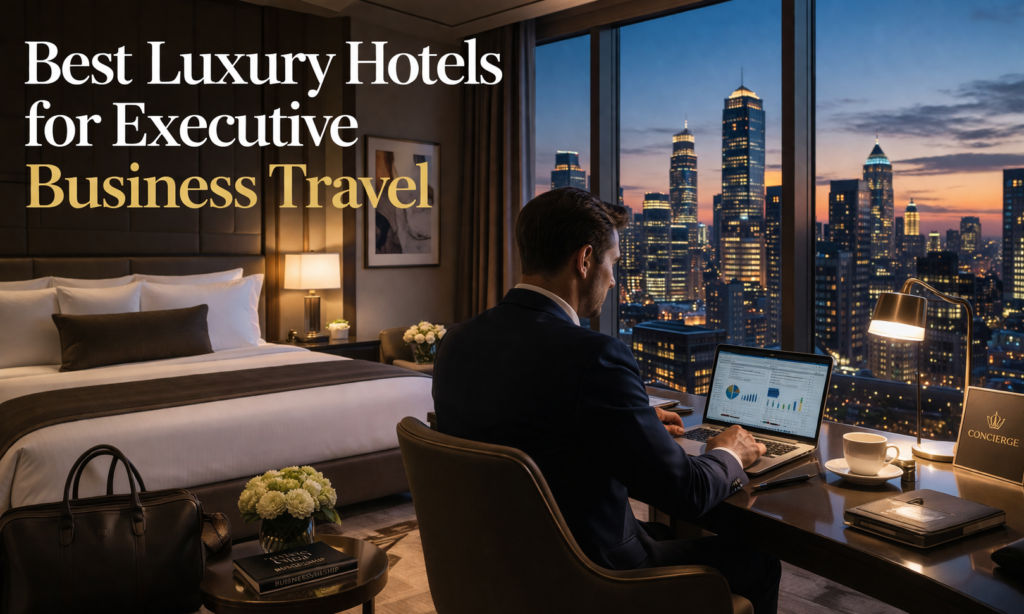
There is also a human reality underneath the spreadsheets. Executive trips compress long hours, public-facing meetings, time-zone strain, decision fatigue, and constant transitions into a very small window. A hotel that looks glamorous on Instagram but fails at soundproofing, in-room work ergonomics, fast check-in, or breakfast efficiency can quietly sabotage performance. On the other hand, a well-run luxury hotel becomes a force multiplier. It gives executives a controlled landing zone where they can prepare for a pitch, take a confidential call, host a small private meeting, recover after a long-haul flight, and move smoothly into the next commitment. That is why the best luxury hotels for executive business travel are not just aspirational properties. They are practical assets. They help protect the one thing senior travelers never have enough of: bandwidth.
What Defines a Luxury Hotel for Executive Business Travel
A true luxury business hotel is not simply a leisure hotel with a boardroom added near the lobby. The distinction shows up in how the entire property is designed around rhythm and discretion. The best executive-friendly hotels understand that time matters more than decoration. They know a guest may need a seamless airport transfer, private arrival, fast but polished check-in, a room that functions as a mini office, and a quiet place to host one or two high-value guests without putting everything on public display. In these hotels, service is anticipatory without feeling intrusive. Staff remember preferences, solve problems quickly, and know how to handle high-profile travelers without making the experience theatrical. Luxury, in this context, means reduced friction.
Productivity-first design is a huge part of that equation. Executive travelers need reliable Wi-Fi, proper desks, multiple charging points, good task lighting, quality coffee, smart room controls, and enough separation between work and rest zones to avoid feeling trapped inside a bland corporate box. But design alone is not enough. Privacy and security are just as important. Senior travelers often carry sensitive devices, hold confidential conversations, and manage commercially important information on the road. The best hotels support that reality through discreet staffing, secure floors, private lounges, well-managed meeting rooms, and excellent transport coordination. This is where the difference between a luxury vacation hotel and a luxury executive hotel becomes obvious. One is built to entertain you. The other is built to protect your focus.
Key Features Executives Should Prioritize
Location is still king, but for executive travelers, the definition of a good location is sharper than the usual tourist checklist. A hotel can be in a famous neighborhood and still be the wrong choice if it adds twenty minutes of traffic to every meeting. The best luxury business hotels sit close to financial districts, embassies, convention venues, corporate headquarters, or major transport hubs. They also balance access with calm. That balance matters because executives often need to move quickly during the day and recover properly at night. Singapore is a strong example of this logic. Its business travel appeal is reinforced by a world-class airport ecosystem, and Business Traveller’s 2025 awards again recognized Singapore Changi as the world’s best airport, which strengthens the city’s status for premium executive mobility.
Meeting infrastructure is another feature people underestimate until it fails. The best executive hotels offer more than a ballroom and some banquet chairs. They provide small, polished meeting rooms, advanced A/V support, business-ready lounge spaces, concierge coordination, executive club access, and staff who understand the difference between a social event and a confidential negotiation. Business Traveller’s roundup of new business hotels highlighted features such as C-suite rooftop boardrooms, private terraces, club lounges, dedicated event teams, 24-hour concierge, strong desk setups, and design-forward meeting rooms. Those details sound small until you are the person trying to close a partnership at 7 a.m. after an overnight flight.
Best Luxury Hotel Brands for Executive Travelers (Best Luxury Hotels)
One of the clearest signals in the market comes from the Business Traveller Awards 2025, where Four Seasons Hotels and Resorts ranked as the best luxury hotel brand in the world, followed by Aman Resorts, Park Hyatt, Shangri-La Hotels, and Mandarin Oriental. That ranking is useful because it reflects both reader sentiment and expert judging, with more than 95,000 individual votes recorded for the awards. It does not mean every property in each portfolio is identical, but it does provide a strong guide to which brands consistently deliver a premium experience that global travelers actually value.
Four Seasons remains the safest all-around choice for executive business travel because it combines polished service, strong urban locations, excellent food and beverage standards, dependable concierge support, and a style of luxury that feels serious rather than showy. For a chief executive, regional managing director, or investor-facing operator, that balance is powerful. The brand works especially well when you need a hotel that can support both formal meetings and personal recovery without forcing a trade-off between the two.
Aman sits in a different category emotionally. It offers exceptional privacy, calm, and a kind of ultra-luxury minimalism that executives often appreciate after overstimulating travel schedules. Aman is not always the first pick for large corporate event infrastructure, but for one-on-one meetings, discreet stays, or top-tier leadership travel, it can be unmatched. It is the hotel equivalent of stepping out of market noise and into a silent, controlled room where your thoughts finally line up again.
Comparison Table: What Executive Travelers Should Look For (Best Luxury Hotels)
| Factor | Why It Matters for Executive Travel | What Great Luxury Hotels Usually Offer |
|---|---|---|
| Location | Cuts travel time and reduces schedule risk | Financial-district access, airport connectivity, premium transport support |
| Room Design | Supports both work and recovery | Large desk, ergonomic chair, strong lighting, quiet layout, charging access |
| Meeting Facilities | Enables private discussions and formal sessions | Boardrooms, A/V support, executive lounges, event staff |
| Privacy & Security | Protects sensitive conversations and devices | Discreet service, secure floors, controlled access, private arrival options |
| Wellness | Improves next-day performance | Quality bedding, gym, spa, healthy dining, blackout curtains |
| Service Quality | Saves time and reduces stress | Fast check-in, responsive concierge, reliable transport coordination |
| Loyalty Value | Improves long-term travel efficiency | Upgrades, points, late checkout, executive benefits |
How Pricing Trends Affect Executive Hotel Decisions (Best Luxury Hotels)
Luxury business travel is becoming more strategic because the underlying economics are still tight. GBTA’s pricing forecast shows global hotel ADR rose to $161 in 2024 and is expected to grow another 1.2% in 2025, while regional rates remain notably stronger in places such as North America, where ADR reached $188, and Asia-Pacific, where rates rose 4.5% in 2024 to $138 and are projected to keep climbing. That tells executives and travel managers something important: premium room rates are not just a temporary spike. They reflect constrained supply, high occupancy, labor costs, and continued demand for quality inventory.
Still, a higher price tag does not automatically mean poor value. In executive travel, the cheapest hotel often becomes the most expensive once you factor in lost time, transport delays, poor sleep, missed working hours, and the need to rent external meeting space. Luxury becomes cost-efficient when it eliminates those hidden frictions. A hotel with an executive lounge, reliable breakfast service, in-room work comfort, and strong location can reduce daily spend elsewhere while raising traveler effectiveness. That is why many companies are not asking whether luxury is expensive. They are asking whether the chosen property is productive. It is a subtle but important shift. A premium hotel should justify itself not only through aesthetics, but through measurable business utility.
Why Loyalty Programs Matter More Than Many Executives Admit (Best Luxury Hotels)
Frequent executive travelers sometimes focus so heavily on property prestige that they overlook the compound value of a good hotel loyalty program. That is a mistake. In the same 2025 Business Traveller awards, Marriott Bonvoy ranked as the best hotel loyalty programme in the world, followed by World of Hyatt, Hilton Honors, Accor Live Limitless, and Shangri-La Circle. For executives who spend dozens of nights a year on the road, that kind of ecosystem can influence room upgrades, early check-in, late check-out, lounge access, elite recognition, and consistency across markets.
Loyalty matters because executive travel is repetitive. One trip may be glamorous, but fifteen trips in six months become a system. A strong program turns that system into leverage. It can smooth arrival experiences, create preferred-room consistency, and add flexibility during schedule changes. That does not mean loyalty should override fit. The best strategy is usually to choose a brand family that matches your main routes and then use flagship properties within that network when business demands a top-tier stay. In other words, prestige gets attention, but repeatability wins the calendar.
Best Cities for Executive Luxury Hotel Stays (Best Luxury Hotels)
Singapore and Tokyo remain two of the strongest cities for executive luxury business travel because they combine safety, efficiency, global connectivity, and high service standards. Singapore benefits from exceptional airport infrastructure and an unusually clean relationship between logistics and hospitality. For executives moving through Asia on dense schedules, that smoothness is priceless. Tokyo, meanwhile, blends elite hotel craftsmanship with deep business relevance across finance, manufacturing, technology, and regional headquarters activity. In both cities, the best luxury hotels understand precision. They do not waste your time, and that is part of the product.
London and New York remain foundational for global executive travel because they sit at the intersection of finance, media, law, consulting, and capital markets. These cities are not always restful, but they are commercially unavoidable. The best luxury hotels there act like insulated command centers. They absorb the noise of the city while keeping the traveler composed inside it. When choosing in these markets, location becomes especially important because traffic, time loss, and neighborhood mismatch can quickly erode the value of even a beautiful property.
Dubai and Hong Kong deserve a place in this conversation because both cities continue to serve as gateway markets for regional and international business. Dubai offers scale, strong premium inventory, and a hospitality culture built around service ambition. Hong Kong remains one of the most naturally suited cities for executive hotel stays because density, business relevance, and luxury hotel standards align so effectively. These cities reward travelers who choose carefully, because the right hotel can compress movement and maximize access in a way that directly improves trip performance.
How to Choose the Right Luxury Hotel for Executive Travel (Best Luxury Hotels)
The smartest way to choose a hotel is to start with the trip objective, not the star rating. Ask a simple question: what must this hotel help you achieve? If the trip is meeting-heavy, prioritize transit efficiency, club access, and private business facilities. If it is investor-facing, prioritize prestige, privacy, and strong food-and-beverage spaces suitable for informal conversations. That it is an international arrival before a major presentation, prioritize recovery: sleep quality, wellness, quiet, and flexible check-in. The wrong hotel choice usually happens when travelers book for image first and function second.
It also helps to think in layers. The first layer is location. The second is room usability. The third is service reliability. The fourth is brand and loyalty fit. If a hotel fails the first two layers, the rest rarely saves it. But when all four align, the property becomes more than accommodation. It becomes infrastructure for leadership performance. That is the real definition of the best luxury hotels for executive business travel. They are not only beautiful. They are useful in the moments that matter most.
Conclusion (Best Luxury Hotels)
The market for executive travel has matured. It is no longer enough for a hotel to call itself luxury and hope that polished marble, a famous chef, and a skyline view will do the rest. Senior travelers need hotels that understand pressure, protect time, and support performance. Current industry data shows business travel remains a major global force, with spending projected to hit $1.57 trillion in 2025, while hotel prices remain resilient because demand for quality stays continues. In that environment, luxury hotels earn their place when they solve real executive problems: fast movement, better sleep, stronger privacy, credible meeting infrastructure, and service that works without drama.